Old Altona in the Eyes of a Jewish Child, Photo Album |
All photo albums |
Homepage |
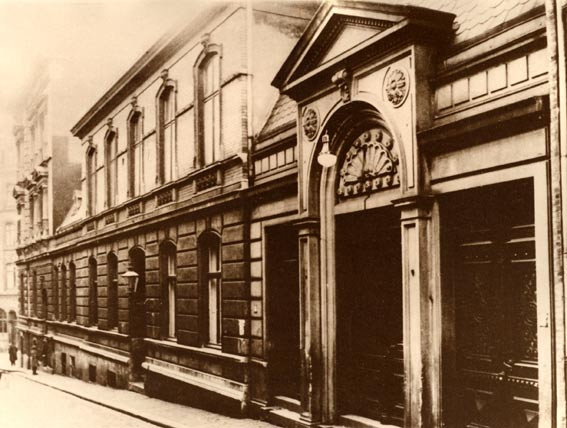
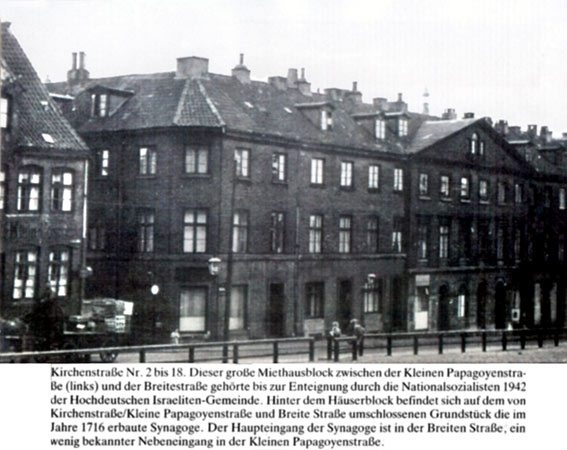
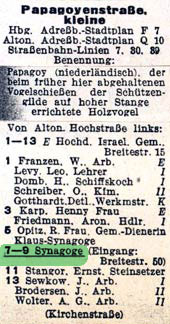
Maybe I should escape to the “Shul” (synagogue), to Papagoyenstrasse 9, the street with the bumpy pavement, push open the heavy brown door and let it slam shut behind me, to cross the long square hall, very slowly, because the large rectangular tiles with the light brown motifs are very slippery, and one could easily loose one’s footing.
It is not generally customary for synagogues to enclose entrance-halls that stretch out to such a length, however here is a tale – so we were told:
For thousands of years and up to the present day, the Kohanim (members of the priestly class who are descendants of Aaron, the High Priest, brother of Moses) are obligated to follow special purity precepts, amongst which is the prohibition to come into contact with the dead. For this reason they cannot participate in funerals, and may only assist with the burial of their nearest relatives. Nevertheless, the duty of paying respect to the dead is regarded as an act of most dignified selflessness, since the deceased cannot reciprocate this kindness. Thus on the request of the Kohanim, the entrance-hall of the synagogue was to serve as a joiner’s workshop, where coffins were made, thereby enabling the priests to participate in the funeral preparations and pay the deceased their last respect. All this is true indeed, even though I had never observed the joinery. Being a girl I only went to Shul on Shabbat and Holidays, days on which no work was carried out …
Inside the hall, there are long rows of brass stands provided with hooks for coats and hats, and towards the end there emerges a small room without windows that functions as a refreshment chamber for the Rabbi after his sermon. And perhaps there is still some coffee remaining in the thermos flask with the detachable lid.
Now I have to go down only the three or four wide stairs, and then I’ll be standing in the men’s section of the Shul. The Holy Ark containing the Torah scrolls is closed, and the embroidered curtain covers both door wings. One may guess how wonderfully dressed and adorned the Torah scrolls are. On the Almemor, the pedestal in the middle of the synagogue, stands the Bima, the elevated reading desk covered with scarlet velvet, upon which the Torah scroll is placed and read aloud, while a little silver pointer may indicate the place from which the reading should proceed. On the wall there’s a marble plate, whose inscription reminds us not to forget to pray for the rain, in the right season.
Looking up, I catch sight of the women’s gallery with its broad-meshed, golden fence. Can one of the women with the covered hair see me caressing the wooden benches, tip down the chair and turn over the leaves of a prayer-book?
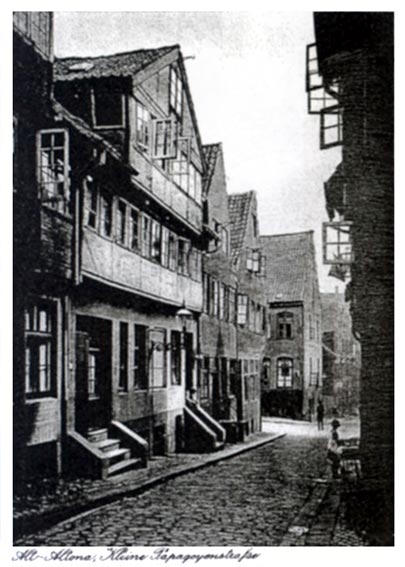
I look up and see no woman, no gallery, I am not in a Shul, because it doesn’t exist anymore, I am not at all in the Papagoyenstrasse, it doesn’t exist anymore either. I am alone in the dark and cannot find my way…
1932

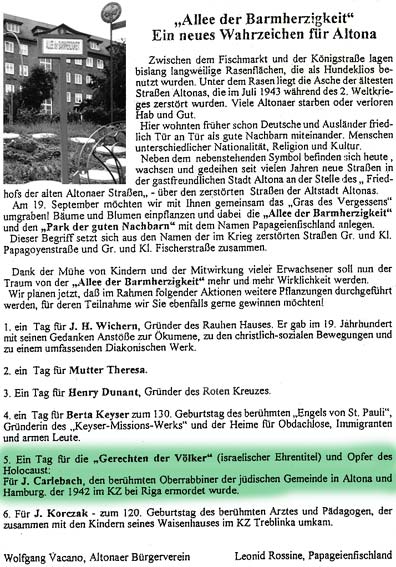
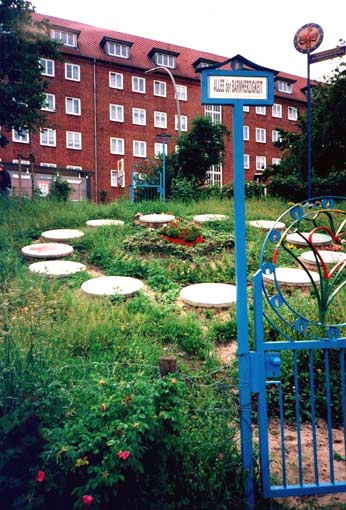
‘Avenue of Compassion’ – a new landmark for Altona
The Square around the Papagoyenstrasse today
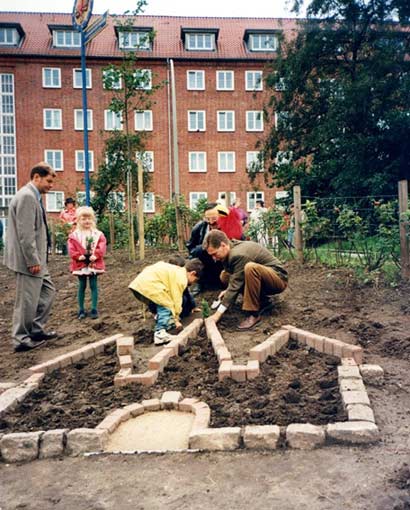
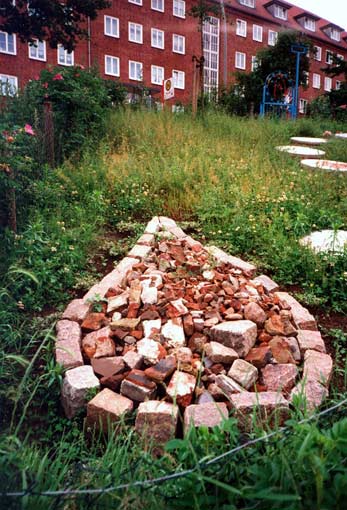
‘A teardrop made of the old houses’ wall remains
 |
 |