
 Julius Neumann was an honorary senator of the town of Altona and member of the board of its Jewish community. He also was a sponsor of the Jewish community school.
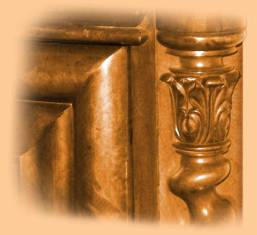
But first and foremost Julius Neumann was the initiator and founder of the Holsatia factories. He established them, with his soul and a sound mind, with energy and a sense for the economy, taking into account the present time and looking forward to the future, with the tireless support of his wife Paula, née Krotochin. His whole family was connected with the Holsatia works in several ways:
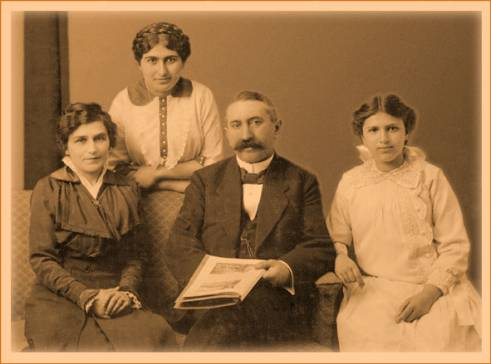
The Neumann family, from left to right: the wife Mrs Paula Neumann née Krotochin), daughter Edith, Julius Neumann, second daughter Elizabeth
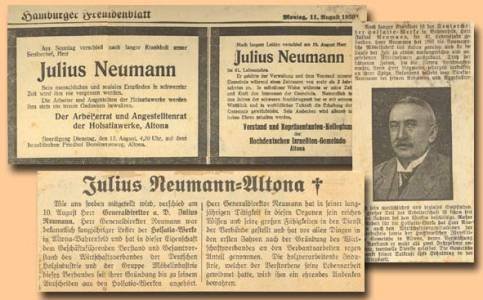
Julius Neumann died early after a long illness. The newspapers were full of obituaries and praise. At the funeral everyone wanted to express his feelings, from the mayor Max Brauer to the foreman of the workers. Letters of condolence came from everywhere.
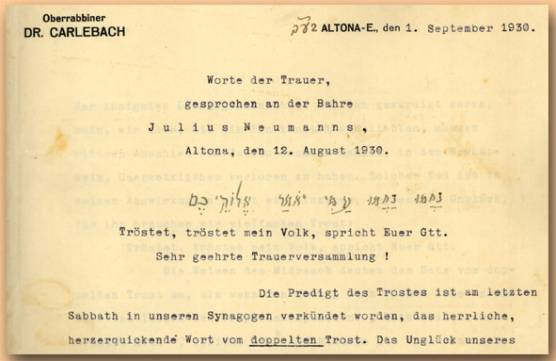
The eulogy of Rabbi Dr Joseph Carlebach ends with the biblical call: “Comfort ye, comfort ye, my people” (Isaiah 40, 1). (gemäß Jesaja 60,1)
“Julius Neumann, a Jewish personality, a man full of energy and ideals, a worker who thought of himself only last of all. He longed for a better and just world. His aim was to scare poverty away … He had a special social conscience … He was inexhaustible in his ideas for the wellbeing of the worker, through saving material and creative simplification. His essence was Jewish. The socialism which he put into effect was that of good deeds by a good human being – an ideal he fulfilled in his life”.
 Back |
 Next |