

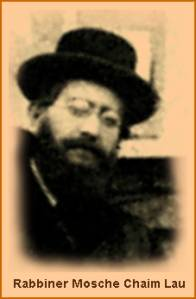
 My father, Rabbi Moshe Chaim Lau, may God avenge his blood, was the last Rabbi of Piotrkow. From my talks with him from time to time, I learned of the close friendship between my father and Rabbi Joseph Carlebach, may God avenge his blood, the last Rabbi of Hamburg-Altona-Wandsbek.
While visiting Rabbi Shmuel Eichenbaum’s farm in the village of Shadlisk near Traveniki, later to become infamous as a training camp for the SS- murderers who headed the concentration and death camps, I learned of the close friendship between my father and Rabbi Carlebach.
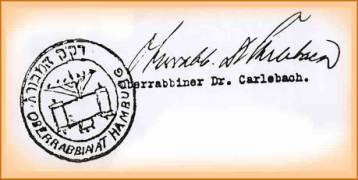
After returning to Piotrkow, I noticed that the two Rabbis were corresponding with each other. Only after World War II broke out, toward the end of 1939, my father dictated me a letter to be typed on the typewriter, addressed to Rabbi Carlebach in Hamburg. I remember the address which I wrote on the envelope: “Ostmarkstrasse, Rabbi Joseph Carlebach, Rabbi of the AHW communities”…
The next time I met the name of Rabbi Carlebach was in February or March 1940. A small package arrived by post from Rabbi Carlebach in Hamburg with the German remark: “Sample without value”. It contained dried figs as “mishloach manot” (gift basket) for the Purim festival. Shortly thereafter, two larger packages arrived, each one weighing 1 kg. They contained round machine baked matzot for the Pessach festival, unlike the usual machine baked matzot, which were square-shaped. The Rabbi and scholars discussed the matter of kashrut (ritual permissibility) concerning this kind of matzot they had never seen before. The discussion ended with my father’s ruling: “Matzot sent by Rabbi Carlebach are unquestionably kosher, maybe even kosher lemehadrin (according to more stringent opinions)…”
Around the time of the Jewish New Year, in autumn 1940, we again received a present from Hamburg. This time it was a wonderful etrog (a special citrus fruit), which the German censor had cut in two!
At the beginning of 1941 the laws enacted by the Nazi occupiers became more and more stringent and the ghetto, which had existed since October 1939 (the first one the Germans had established) was closed almost hermetically. We received mail, yet we were not allowed to send anything. However, even in 1941 we received several packages of matzot, sent by Rabbi Carlebach from Hamburg.
Already after the High Holidays (autumn 1941) we heard about the atrocities committed by the Waffen-SS in East Galicia and the Ukraine and about the Wehrmacht’s entry into Russia. In course of father’s attempts to contact the outside world, Rabbi Carlebach’s name was mentioned several times – as a possible contact address.
My father wrote a short letter in Hebrew full of code words in Hebrew and Aramaic. He asked me to write Rabbi Carlebach’s address in German block letters on the envelope, without mentioning the name of the sender. I wrote down the address I knew, but forgot to write “Israel” next to the name Joseph – as German Jews had been ordered to. My father decided to send this letter without this Jewish “hallmark”. The letter was sent with the help of a non-Jew from outside the ghetto, and after about a month Rabbi Carlebach’s answer arrived, wherein he hinted at the upcoming pogrom threatening his community.
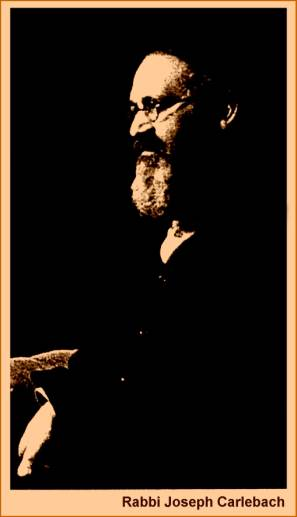
Several weeks later two youngsters came to our ghetto: Chaim Jerachmiel Widewski and Yitzchak Jostmann who had fled from Chelmno, the first death camp where they used gas as a killing method. They told us what they had seen. Nobody believed them. But this testimony together with a postal card from Rabbi Carlebach strengthened our feeling of an approaching disaster. It befell us in October 1942 when my father, Rabbi Lau, and my younger brother Shmuel Yitzchak, together with 28.000 Jews from Piotrkov, were sent to the gas chambers of Treblinka.At about that time we received a postal card from somewhere in Eastern Prussia, according to the post stamp, which somebody succeeded in deciphering. This is what Rabbi Carlebach wrote:
These lines are carved in my memory. However, at the end of the few sentences he expressed his hope of meeting again, honoring each other at the various family celebrations…
 Back |
 Next |