
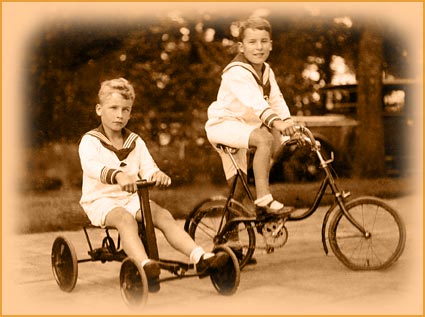
As children we were friendly with the two boys, Walter and Lutz. Like us Carlebach children, they attended the Jewish Community Day School of Altona at first; maybe because it was near their home, on the same side of the road. But even after they changed to the Christianeum Gymnasium (Highschool), they kept in touch with the Jewish school. Above all, both boys took part in most celebrations or performances of the Jewish school: black-haired Walter playing the violin and blond, blue-eyed Ludwig, called Lutz, playing the flute.
In 1935, both Lichtheim boys still participated in a school performance in honor of the Chanukah festival, playing the role of the “two brothers” in the play “Moriah”, written by the teacher Philipp Moddel. Mount Moriah symbolized “the peak of glory” on one hand, and “a modest memorial of suffering” on the other hand…
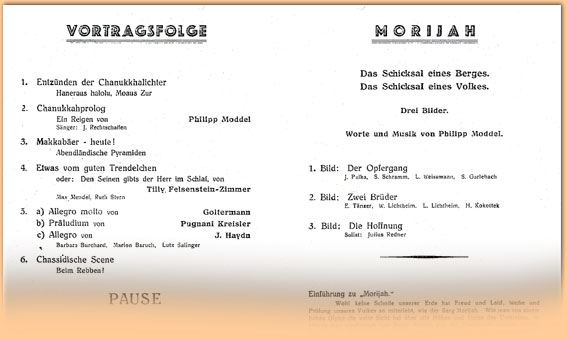
The program of the Chanukah party
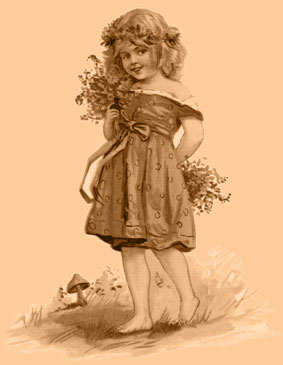
Walter also participated in other children plays performed for parents and pupils. He was the violinist looking for “Mary in the meadow”. A beautiful stage set with flowers served as meadow. Rebbetzin Lotte Carlebach “lent” her delicate, four-year-old daughter Noemi to the play – as “Mary in the meadow”, dressed in a green flower-decorated dress. Walter’s violin accompanied the small children’s choir, at the beginning very softly, accentuating the sad part when the girl had gotten lost, and at the finale playing a merry tune, his violin rejoicing: “I found her, I found her in the grass…”
Johannes Trojan 1837-1915
Melody – Carl Hess
I am so scared
Because I can not see her anywhere
I lost her
I lost her in the pasture.
Among white star flowers
And blue bellflowers,
Amid golden buttercups
Look what I see!
This is no star flower,
It is a little head,
I have found her,
Found her in the pasture.
Another play dealt with a biblical story. In a so-called shadow play, Walter – then about 13 years old – played the role of Joseph, and I – three years younger and very small for my age – was little brother Benjamin. I played my role quite well behind the sheet, until Joseph, that is Walterle, exclaimed: “Come close to my heart, my Benjamin…” – Out of sheer fright, I fell between the stage and the shadow sheet.
Consequently the following question arises: To what extent are these miniature scenes and recollections of any historical value?
They describe the acute, brusque transition from innocence, childish naivety and youthful creativity into a sudden, abrupt, and sophisticated cruelty – without the slightest offence on part of the Jewish children, of their school and their community.
Walter, then at the age of Bar Mitzvah, was murdered ten years later, together with his mother, Mrs. Margarethe Lichtheim, and his aunt, Mrs. Gertrud Monasch – at Death Camp Chelmno in May 1942.
Is there any more need to ask about the connection?
 Homepage |
 Next |